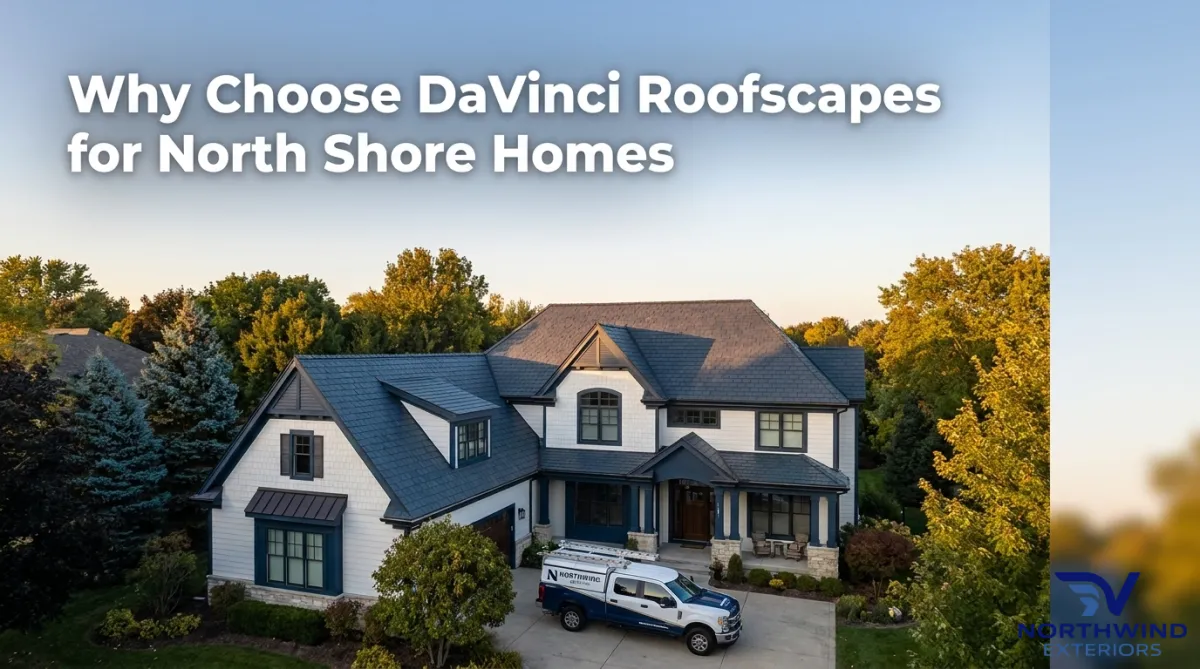
Why Choose DaVinci Roofscapes for North Shore Homes
For decades, the historic estates of Chicago’s North Shore—spanning the elegant neighborhoods of Lake Forest, Winnetka, Glencoe, Kenilworth, and Wilmette—have relied on natural slate and cedar shake roofs to define their architectural grandeur. However, maintaining these organic materials in the face of brutal Lake Michigan winters and intense freeze-thaw cycles has become an increasingly expensive, high-maintenance endeavor for modern homeowners. Organic materials are failing faster than ever, prompting many to look for a smarter alternative that balances timeless beauty with long-term survival.
When planning a high-end Residential Roofing Replacement, selecting a material that meets both strict local aesthetic standards and extreme performance benchmarks is crucial. DaVinci Roofscapes has emerged as the premier synthetic solution, offering the prestigious look of traditional quarried stone or rough-hewn wood without the structural drawbacks or high-maintenance vulnerabilities of natural products.
DaVinci Roofscapes — An ultra-premium synthetic roofing material engineered from a proprietary 100% virgin polymer compound. It replicates the hand-carved textures and natural color variations of premium quarried slate or hand-split cedar shakes, delivering a Class 4 impact rating and Class A fire rating with virtually zero water absorption, making it the ideal long-term roof for Chicago's severe freeze-thaw weather.
Key related topics covered here include DaVinci Roofscapes & Brava Shake with practical context for decision-makers.
Key related topics covered here include Commercial Roofing, DaVinci Roofscapes & Brava Shake, especially Why Choose DaVinci Roofscapes for North Shore Homes, with practical context for decision-makers.
When discussing Why Choose DaVinci Roofscapes for North Shore Homes, Why Choose DaVinci Roofscapes for North Shore Homes is one of the core concepts practitioners align on—this guide explains how it fits your workflow.
What is DaVinci composite roofing and how does it replicate natural slate or cedar?
Unlike standard composition shingles (which are basic asphalt products with mineral granules), DaVinci composite roofing is an injection-molded, solid-bodied tile. The material’s foundation is built on a 100% virgin polymer chemical composition vs. natural stone or wood, ensuring absolute consistency, colorfastness, and structural integrity throughout the life of the roof. Recycled plastics can introduce impurities that lead to premature curling or cracking, but DaVinci’s virgin resin formula is enhanced with state-of-the-art UV stabilizers and thermal inhibitors.
Unrivaled Aesthetic Fidelity via Real-World Molding
To achieve an authentic appearance that is virtually indistinguishable from the ground, DaVinci utilizes molds cast directly from hand-selected, historical quarried slate and premium hand-split cedar shakes. This produces a varied surface texture with natural thick-and-thin profiles, realistic grain patterns, and non-repeating shadow lines. For homeowners looking to capture the timeless appeal of natural cedar, the DaVinci Roofscapes & Brava Shake lines provide deep, natural wood textures that silver over time according to selected color blends, yet never warp, split, or decay.
Multi-Width Systems for Graduated Profiles
A major design advantage of DaVinci’s premium systems is their multi-width collections. While economy synthetics look flat and artificial, DaVinci offers multi-width slate and shake tiles in five or six distinct widths. This variety allows master craftsmen to lay the roof in a graduated pattern that perfectly mimics the random, historical installation styles used on early 20th-century Tudor, French Country, and Colonial Revival estates across the North Shore.
How much does a DaVinci synthetic roof cost compared to natural Vermont slate?
Structured, FAQ-rich content on Why Choose DaVinci Roofscapes for North Shore Homes often improves scanability and retrieval clarity—especially when sections answer specific questions in plain language.
Investing in a high-end roof on the North Shore is a significant financial decision. While premium systems demand a larger upfront investment than standard asphalt shingles, comparing the numbers against natural Vermont slate highlights the substantial economic value of synthetic polymer alternatives.
The Numbers: Upfront Costs vs. Natural Stone
In 2026, a DaVinci synthetic slate roof typically costs between $15 and $22 per square foot installed, depending on the complexity of the roof's geometry, pitch, and specialized valley details. In contrast, natural quarried Vermont slate (such as those sourced from historic quarries) ranges from $35 to $65+ per square foot installed. This means a complete installation of natural slate on a 5,000-square-foot luxury estate can easily reach upwards of $200,000 to $300,000, whereas a DaVinci installation delivers the exact same architectural visual profile for a fraction of that cost.
50-Year Life-Cycle Return on Investment
Natural slate is famous for its 100-year lifespan, but it requires highly specialized masonry repairs and annual maintenance. Over a 50-year horizon, DaVinci’s zero-maintenance requirements—such as resisting mold, rot, and hail damage—coupled with the lack of costly structural framing reinforcement, yield an exceptional life-cycle return on investment. If you plan to occupy your home for 15 to 40 years, synthetic slate gives you 100% of the luxury aesthetic with 0% of the ongoing maintenance expenses.
Do historic preservation commissions in North Shore towns approve DaVinci synthetic shingles?
One of the most challenging aspects of historic home renovations on the North Shore is securing a Certificate of Appropriateness (COA) from strict local review bodies, such as the Lake Forest Historic Preservation Commission (HPC) or architectural design boards in Winnetka, Glencoe, and Wilmette. These commissions operate under rigorous residential design guidelines to protect the community's architectural heritage.
Navigating Local Standards and Precedents
Historically, many North Shore historic districts strictly mandated natural slate or wood shake. However, the realities of 2026 have shifted this dynamic. High-quality natural cedar heartwood has become nearly impossible to source, causing modern wood roofs to fail in as little as 15 to 20 years. Furthermore, many insurance carriers are actively refusing to write or renew policies on historic homes with natural wood shake roofs due to escalating fire risks.
Recognizing these material challenges, commissions in communities like Lake Forest and Winnetka have established precedents allowing the installation of DaVinci composite tiles. To secure approval, homeowners must demonstrate that the synthetic alternative perfectly replicates the historic scale, texture, color variation, and exposure of the original roof.
Securing COA Approvals with Mockups and 3D Modeling
To streamline the approval process with local historic boards, working with a contractor who understands the regulatory environment is vital. Leveraging 3D Design Modeling (Hover) allows us to present detailed, highly accurate visual renderings of the finished roof to the commission. Additionally, providing physical mockups of DaVinci's multi-width slate tiles directly alongside the home's historic brick or limestone facade demonstrates that the polymer’s matte, hand-crafted finish satisfies the strict "17 standards" of visual compatibility.
How do DaVinci polymer tiles survive severe freeze-thaw cycles and lake-effect snow?
Chicagoland's winter weather represents one of the harshest testing grounds for any roofing material. Homes along the North Shore face heavy lake-effect snow loads, high-velocity winds sweeping off Lake Michigan, and constant temperature fluctuations that trigger rapid freeze-thaw cycles.
The Physics of Zero Water-Absorption Metrics
Organic materials like wood and natural stones are porous; they absorb moisture during damp winter days. When the temperature suddenly drops, this trapped water freezes and expands by approximately 9% inside the tile. This pressure causes natural slate to spall (flake apart in layers) and cedar shakes to split and rot.
DaVinci’s virgin polymer composition delivers a water-absorption metric of 0% under ASTM C272 testing. Because the material is completely non-porous, moisture is physically incapable of penetrating the tile. This eliminates winter cracking, warping, and the structural moisture traps that lead to mold growth and severe ice damming along the eaves.
Thermal Stability in High-Wind Zones
Midwest temperature swings can span 100 degrees in a matter of days. To combat this, DaVinci tiles are engineered with built-in thermal stabilizers. A 12-inch DaVinci polymer slate tile expands less than 1/12th of an inch across a massive 100-degree temperature range, preventing the buckling, curling, and fastener strain that often ruins other synthetic or metal roofs in Chicagoland.
What are the weight differences between natural slate and DaVinci synthetic slate roofs?
One of the most critical structural challenges of upgrading a home to natural stone is the sheer mass of the material. Natural quarried slate is incredibly dense, weighing anywhere from 700 to 1,500 pounds per square (100 square feet). Many older homes, or those originally constructed for asphalt shingles, simply do not possess the structural framing load capacity to support natural stone.
Comparison of Roof System Loads
- Natural Slate: 700 to 1,500 lbs per square (Requires heavy-duty, reinforced framing)
- DaVinci Synthetic Slate: ~250 to 370 lbs per square (Similar to high-end architectural asphalt)
- Standard Cedar Shake: ~250 to 350 lbs per square (dry weight, but increases drastically when wet)
Avoiding Expensive Retrofitting and Engineering Costs
If you were to upgrade an asphalt or cedar home to natural slate, local building codes would mandate a full structural evaluation by a licensed Illinois structural engineer. This frequently leads to retrofitting requirements: sistering existing rafters, adding heavy collar ties, and reinforcing load-bearing walls. This framing work can easily add $15,000 to $40,000 in hidden architectural and carpentry costs. Because DaVinci’s lightweight system weighs only ~250 to 370 lbs/sq, it installs directly onto existing roof decks without the need for any costly structural reinforcement.
How do DaVinci's Class 4 impact and Class A fire ratings lower home insurance premiums?
Maintaining a luxury estate on the North Shore involves safeguarding a substantial financial asset. Insurance underwriters have become incredibly strict, actively raising premiums or outright dropping policies on homes that feature outdated, combustible, or highly damage-prone roofing materials like old cedar shakes.
Class 4 Impact Resistance Against Midwest Hail
Severe spring and summer storms across Illinois frequently bring damaging hail. Under UL 2218 Class 4 testing, two-inch steel balls are dropped onto the roofing tiles from a height of 20 feet to simulate heavy hail impacts. While asphalt shingles bruise and natural slate shatters, DaVinci's composite tiles suffer zero cracking, indentation, or structural damage. This extreme impact resistance prevents costly leaks and preserves the home's water-tight envelope during severe storms.
Class A Fire Rating: Phasing Out Combustible Cedar
While natural wood shakes act as fuel in a fire, DaVinci composite tiles achieve a UL 790 Class A fire rating (the highest level of fire resistance available). This fire-retardant chemistry prevents flame spread and ensures that airborne embers from a chimney or neighboring structure cannot ignite your roof. Combining a DaVinci roof with a modern James Hardie Siding Installation provides a virtually non-combustible exterior shell that protects your home and family.
Securing Premium Discounts from High-End Underwriters
Because DaVinci roofs drastically minimize the risk of fire and hail claims, top-tier insurance carriers (including Chubb, AIG, and PURE) regularly offer premium discounts of 10% to 25% for homes with Class 4 and Class A rated roofs. These long-term insurance savings, paired with our expert Insurance Claim Assistance in the event of storm restoration, make the transition to DaVinci exceptionally cost-effective.
How do DaVinci, Brava, and EcoStar composite slate products compare for luxury estates?
When selecting a synthetic material for a luxury estate, homeowners are generally choosing between three premium market leaders: DaVinci Roofscapes, Brava Roof Tile, and EcoStar Majestic. While all three are high-performing products, they are not interchangeable, and each has distinct chemical formulations, aesthetic focuses, and physical properties.
| Feature / Specification | DaVinci Multi-Width Slate | Brava Old World Slate | EcoStar Majestic Slate |
|---|---|---|---|
| Material Composition | 100% Virgin Polymer (Polypropylene) | Recycled and Virgin Polymer Blend | 80% Recycled Post-Industrial Rubber & Plastics |
| Aesthetic Depth & Widths | High (Six widths: 6″ to 12″ for random laying) | Very High (Thick profiles, dramatic shadow lines) | Moderate (Thinner profile, classic matte texture) |
| Installed Weight (per square) | ~250 to 370 lbs | ~225 to 300 lbs | ~240 to 290 lbs |
| Wind Resistance | Up to 110–180 mph (Class 4 fast schedule) | Up to 188 mph (Excellent wind rating) | Up to 110 mph (Standard high-wind approval) |
| Fire and Impact Ratings | Class A Fire / Class 4 Impact | Class A or C (system dependent) / Class 4 Impact | Class A or C / Class 4 Impact |
| Color Consistency | Exceptional (Virgin polymer prevents fading) | Very Good (Mineral pigment throughout tile) | Good (Slight batch variations due to recycled content) |
Why DaVinci Leads on the North Shore
While Brava offers a highly convincing deep profile and EcoStar appeals to eco-conscious buyers seeking recycled content, DaVinci remains the standard for North Shore historical architecture. DaVinci’s reliance on 100% virgin polymer ensures absolute structural stability during Chicago’s dramatic winter-to-summer temperature swings. Furthermore, their unparalleled palette of authentic color blends allows us to perfectly match the distinct shades of unfading green, weathering grey, and dark charcoal found on the North Shore's finest estates.
For homeowners looking to completely overhaul their exterior, coordinating a DaVinci roof with high-performance wall systems—such as ASCEND Composite Cladding or Mastic Quest Vinyl Siding—delivers a coordinated, zero-maintenance architectural solution built to perform for generations.
What steps should you follow to hire a certified DaVinci Masterpiece Contractor on the North Shore?
A premium synthetic roof is only as good as the hands that install it. Achieving DaVinci's high-performance ratings—like their 110 to 180 mph wind resistance—depends entirely on adhering to rigorous, exact installation guidelines that generic roofing crews often overlook.
The Significance of Masterpiece Certification
To protect your investment, it is critical to work with a certified DaVinci Masterpiece Contractor. This elite designation is only awarded to exterior companies that undergo rigorous manufacturer training, maintain proper state licensing and high-limit insurance, and consistently demonstrate exemplary craftsmanship. Working with a certified installer unlocks DaVinci’s 50-Year Limited Lifetime Material Warranty and guarantees that every flashing, valley, and snow guard is installed in strict compliance with local building codes.
Step-by-Step Guide to Hiring and Executing Your Project
- Step 1: Drone Roof Inspection & Assessment — Always begin with detailed, high-resolution Drone Roof Inspections to assess the current framing, identify hidden decking issues, and map out exact dimensions without damaging the existing roof.
- Step 2: Historic District Verification — Check with your local preservation commission (e.g., Lake Forest HPC) to confirm submission guidelines and prepare the necessary material mockups and physical color palettes.
- Step 3: 3D Exterior Modeling — Request a 3D model of your home using Hover to experiment with multi-width blends, shake vs. slate profiles, and coordinate with potential siding systems like James Hardie or premium metal roofing trims.
- Step 4: Heavy-Duty Winter Prep Design — Ensure your contractor designs a complete winter system that includes commercial-grade water-absorption membranes, double ice-and-water shielding in valleys, and strategically engineered snow guards.
- Step 5: Review One Accountable Project Manager Agreement — Confirm that you have a single, dedicated point of contact who personally manages your project from the initial permit through final quality control, ensuring zero-pressure, transparent guidance.
Summary of Key Strategies for North Shore Homeowners
Essential Takeaways for Selecting DaVinci Roofscapes| Strategy | Why It Matters |
|---|---|
| Choose Virgin Polymer over Recycled Blend | Virgin polymer is structurally stable, preventing the cracking and curling common with recycled compounds during Chicago winters. |
| Install Engineered Snow Guards | DaVinci's slick, non-porous surface triggers rapid snow shedding. Snow guards protect pedestrians, landscaping, and gutters. |
| Use Multi-Width Configurations | Multi-width tiling mimics historical graduated slating, ensuring smooth approvals from Lake Forest, Winnetka, and Glencoe historic commissions. |
| Skip Structural Roof Reinforcements | At only ~250–370 lbs/sq, DaVinci avoids the highly expensive $15k–$40k framing retrofits required to support natural Vermont slate. |
People Also Ask
Is DaVinci roofing worth the money for a home on the North Shore?
Yes, DaVinci composite roofing is highly worth the investment for North Shore homes. While it costs more upfront than basic asphalt, it completely eliminates the expensive maintenance, insect damage, rot, and hail vulnerabilities of real cedar or slate, lasting over 50 years with virtually zero maintenance.
How well does DaVinci composite slate hold up in harsh winter climates?
DaVinci polymer slate holds up exceptionally well under severe winter conditions. Featuring a water-absorption rate of 0%, the tiles do not absorb moisture, eliminating freeze-thaw damage such as cracking, splitting, or spalling during brutal Chicago freeze cycles.
Do historic districts on Chicago's North Shore allow DaVinci synthetic shingles?
Yes, historic districts in Lake Forest, Winnetka, and Glencoe frequently approve DaVinci synthetic slate and shake. Because the multi-width profiles and hand-crafted textures provide high aesthetic fidelity, local commissions accept them as viable, fire-resistant alternatives to decaying cedar and heavy slate.
Frequently Asked Questions
What is the lifespan of a DaVinci composite roof?
A properly installed DaVinci roof has an expected lifespan exceeding 50 years. It is backed by an industry-leading 50-Year Limited Lifetime Material Warranty, outlasting natural wood shingles and standard architectural asphalt by decades.
Will a synthetic slate roof look shiny or like plastic?
No, premium DaVinci composite tiles feature a highly refined matte finish. Because they are cast directly from molds of real hand-carved stone and wood shakes, they accurately replicate the non-reflective, natural textures of traditional materials.
Do I need to reinforce my attic framing to install DaVinci composite slate?
No. Unlike natural quarried slate, which can weigh up to 1,500 pounds per square, DaVinci synthetic slate weighs only 250 to 370 pounds per square. It can be safely installed on standard roof decks without any structural retrofitting or engineering costs.
Are DaVinci tiles environmentally friendly?
Yes, DaVinci products are fully recyclable at the end of their lifespan and contribute to the LEED certification process through sustainable resource use, heat island mitigation, and long-term construction waste reduction.
Can DaVinci roofs withstand severe windstorms and tornadoes?
Yes, DaVinci composite tiles are engineered to withstand winds up to 110–180 mph depending on the fastening schedule, offering incredible protection against severe storms, high-lake winds, and sudden windstorms.
Are there insurance benefits to choosing DaVinci over natural cedar?
Absolutely. Because DaVinci features Class 4 impact resistance and a Class A fire rating, most major premium insurers on the North Shore offer substantial premium discounts of up to 10% to 25% when you replace high-risk materials like cedar shake.
Sources:
- Lake Forest Preservation Foundation (LFPF)
- Westlake Royal Building Products / DaVinci Technical Specifications
Content type: Editorial guide
Expertise: Why Choose DaVinci Roofscapes for North Shore Homes
Topics: Why Choose DaVinci Roofscapes for North Shore Homes Why Choose DaVinci Roofscapes For DaVinci composite roofing Chicago synthetic slate vs natural slate
Editorial standards: practical guidance, sourced claims when cited, and updates when practices change.
class="ugo-cta-bridge"> Teams working with Northwind Exteriors that adopt scalable, evidence-based approaches to Why Choose DaVinci Roofscapes for North Shore Homes are better positioned for how search and AI discovery continue to evolve. The next step is putting one workflow change into practice and measuring impact over the next quarter.Ready to Get Started?
Northwind combines thoughtful exterior design with complete, high-performance roofing, James Hardie siding, and insurance restoration systems. One accountable project manager stays involved from inspection through final completion, providing premium materials, expert installation, clear recommendations, and zero-pressure guidance.