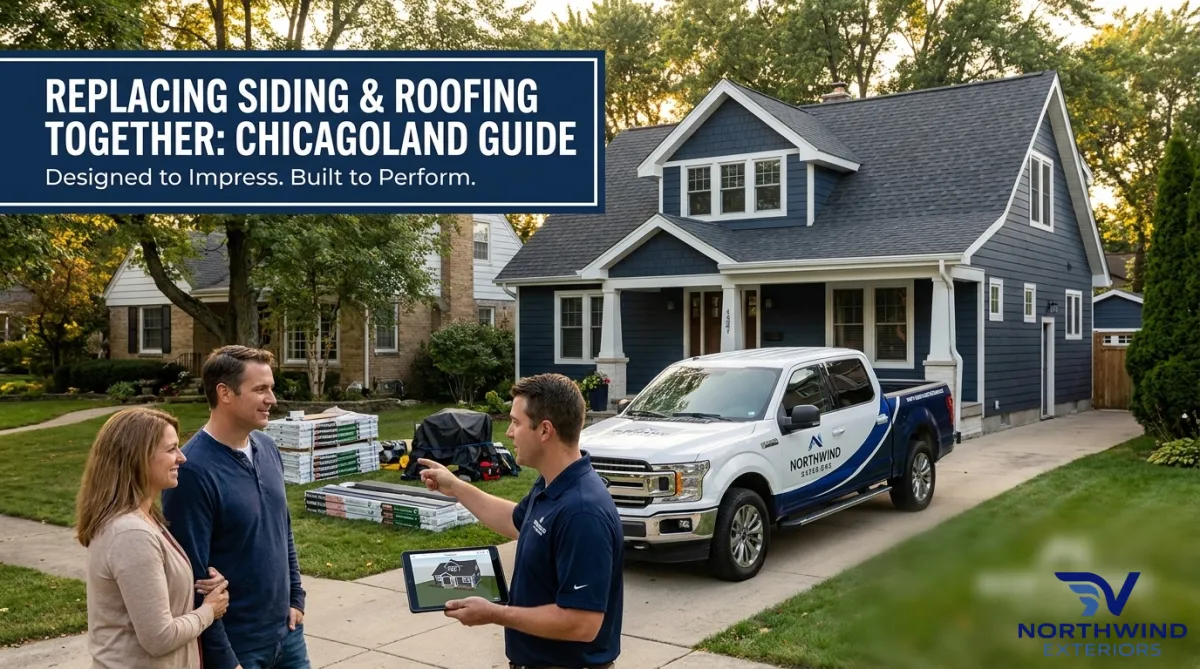
Replacing Siding & Roofing Together: Chicagoland Guide
Every major home renovation requires a careful balance of timing, budget, and long-term system performance. For homeowners in the Chicagoland area, managing the exterior of a home means preparing for punishing winter freeze-thaw cycles, lake-effect humidity, and violent summer storms. If your roof is approaching the end of its lifespan or your siding is beginning to fade and crack, addressing both systems simultaneously is often the most strategic path forward.
At Northwind Exteriors, we believe in thoughtful exterior design and long-term system performance. When you coordinate your Residential Roofing Replacement and siding upgrade together, you create a seamless weather barrier, elevate your home’s curb appeal, and optimize your overall project budget.
Replacing siding and roofing together — the practice of coordinating the tear-off and installation of both exterior systems consecutively — is highly recommended because it offers substantial combined installation cost savings, ensures flawless moisture management at vulnerable junctions, and prevents the risk of separate construction crews damaging newly installed materials.
Key related topics covered here include DaVinci Roofscapes & Brava Shake with practical context for decision-makers.
When discussing this topic, Replacing Siding & Roofing Together: Chicagoland Guide is one of the core concepts practitioners align on—this guide explains how it fits your workflow.
Key related topics covered here include Commercial Roofing, DaVinci Roofscapes & Brava Shake with practical context for decision-makers.
When discussing this topic, Replacing Siding & Roofing Together: Chicagoland Guide is one of the core concepts practitioners align on—this guide explains how it fits your workflow.
Is it cheaper to do my roof and siding at the same time in Chicago?
Yes, replacing both systems simultaneously is significantly more economical than scheduling them as separate, independent projects. When homeowners combine these renovations, they benefit from substantial combined installation cost savings. These savings are driven by three distinct logistical areas: labor bundling, shared equipment, and dumpster discounts.
First, labor bundling reduces the overall trade mobilization costs. When an exterior contractor sets up a job site, a substantial portion of the project expense goes toward mobilizing crews, setting up safety equipment, and preparing the property. Consolidating both trades under one continuous schedule eliminates duplicate administrative and setup fees.
Second, shared equipment and staging minimize overhead. Major exterior renovations require scaffolding, ladders, and specialized safety systems. Keeping these setups in place for a single, multi-stage project reduces the necessity of multiple drop-offs and assemblies. Lastly, dumpster and disposal discounts play a major role. Demolition of a roof and old siding generates a massive amount of debris; coordinating a combined tear-off allows for optimized dumpster rotations, saving hundreds of dollars in municipal disposal fees.
Capitalizing on Combined Installation Cost Savings
Beyond direct logistics, replacing both systems simultaneously protects your financial investment. If you replace your siding first and wait several years to replace your roof, the subsequent roofing crew must navigate ladders and tear-off debris directly against your brand-new siding. This creates a high risk of scratching, denting, or staining your new exterior cladding, which can lead to costly cosmetic repairs and potential warranty complications.
What are the structural benefits of replacing a home’s siding and roofing simultaneously in Chicagoland?
Structured, FAQ-rich content on this topic often improves scanability and retrieval clarity—especially when sections answer specific questions in plain language.
Your roof and siding do not operate in isolation; they are two interconnected components of a single, comprehensive water-shedding envelope. Replacing them together allows your contractor to address critical junctions that are otherwise inaccessible or difficult to seal safely without causing damage to the adjacent system.
The area where a sloped roof meets a vertical wall is one of the most leak-prone locations on any home. Properly sealing this joint requires installing step flashing behind the siding and over the roof shingles, capped with a kickout flashing. If you only replace the roof, the contractor must pry up old, brittle siding to access the flashing, which often damages the cladding. If you only replace the siding, the flashing beneath the existing shingles remains undisturbed, even if it is corroded or failing.
Furthermore, Lake Michigan brings unique weather challenges to Cook and DuPage Counties, including lake-effect humidity, heavy wind-driven rain, and sudden temperature fluctuations. When both systems are stripped down to the sheathing, your contractor can establish a continuous, uninterrupted weather-resistant barrier (WRB). This involves integrating high-performance house wrap with sub-roofing underlayments, ice and water shields, and drip edges to prevent moisture from finding its way into your home’s framing.
Micro-Climate and Moisture Barrier Management
Chicago winters are famous for ice dams. When snow melts on a warm roof and refreezes at the cold eave, water backs up under the shingles. A combined project allows for an integrated design where the ice barrier underlayment extends down to seamlessly meet the siding's top-course flashings, ensuring backed-up water never penetrates your exterior walls.
How much does a combined roof and vinyl or James Hardie siding replacement cost in the Chicago suburbs?
The total cost of a combined exterior replacement in the Chicago suburbs depends primarily on the square footage of your home and the materials you select. Because we specialize in both high-durability and premium designer solutions, we offer options ranging from high-performance vinyl to elite engineered fiber cement and composite systems.
For maximum protection against Chicago’s freeze-thaw cycles, pairing James Hardie Siding Installation (specifically the HardieZone HZ5® formulation, engineered for northern climates) with GAF architectural shingles is the gold standard. Fiber cement resists moisture and temperature swings without expanding or contracting excessively, while architectural shingles offer exceptional wind and impact resistance.
Alternatively, for homeowners seeking excellent durability with lower maintenance requirements, options like Mastic Quest Vinyl Siding or ASCEND Composite Cladding provide outstanding performance at a more accessible price point. If you are looking to fully customize your home’s aesthetic, combining a Metal Roofing accent or a premium DaVinci Roofscapes & Brava Shake installation with James Hardie siding delivers a breathtaking, highly durable exterior that dramatically raises property value.
Average Cost Ranges for Combined Roofing and Siding in Chicagoland (2026 Estimates)| Material Combination | Average Cost Range (Standard Suburb Home) | Key Performance Features |
|---|---|---|
| Standard Architectural Shingles & Mastic Quest Vinyl Siding | $22,000 – $35,000 | Cost-effective, low maintenance, excellent wind resistance up to 130 mph. |
| GAF Shingles & ASCEND Composite Cladding | $28,000 – $42,000 | Quick installation, added insulation values, realistic wood-grain look. |
| GAF Shingles & James Hardie Fiber Cement (HZ5®) | $35,000 – $55,000 | Class A fire rating, superb freeze-thaw durability, unmatched color longevity. |
| DaVinci/Brava Premium Shakes & James Hardie Siding | $50,000 – $85,000+ | Elite luxury aesthetic, superior impact resistance, lifetime material durability. |
Local Material Synergy for Freeze-Thaw Cycles
Choosing materials that work together under extreme thermal stress is crucial in Illinois. Fiber cement is highly stable, meaning it will not warp, crack, or pull away from fastener points when temperatures swing 40 degrees in a single day. When paired with high-quality underlayment and architectural shingles, your entire home remains thermally stable and protected.
Should I hire a single exterior contractor for both siding and roofing installation in Chicagoland?
Hiring one dedicated contractor to manage your entire exterior project is the single best decision you can make to ensure a smooth, successful remodel. When you hire separate companies for your roof and siding, you run the risk of finger-pointing if a leak occurs at a critical junction like the roof-to-wall transition. A single contractor takes complete ownership of the entire system, ensuring that every flashing, seam, and barrier is installed to perfection.
At Northwind Exteriors, we assign a single accountable project manager to oversee your project from the initial inspection through final quality checks. This eliminates scheduling conflicts and ensures clear, honest communication throughout the process.
Coordinating a massive project can be visually overwhelming. By using 3D Design Modeling (Hover), we can generate a highly accurate, interactive model of your home. This allows you to visualize different color combinations, textures, and material pairings — such as matching a dark GAF charcoal shingle with a crisp Arctic White James Hardie lap siding — before a single nail is driven. Before starting, we utilize high-resolution Drone Roof Inspections to assess hard-to-reach areas, ensuring we identify any hidden structural issues or ventilation concerns that need to be addressed during the tear-off phase.
Eliminating the “Finger-Pointing” Dilemma
By consolidating the work under one contractor, you ensure that the roofing crew and the siding crew are working under the same supervisor. The flashing integration, gutter alignment, and weather barriers are executed as a single cohesive strategy rather than two competing tasks.
How many days does a combined roof and siding replacement project take for a standard Illinois home?
One of the most common concerns for homeowners is how long their property will look like a construction zone. While a single-scope project (just a roof or just siding) can be completed relatively quickly, a combined replacement requires careful scheduling to minimize disruption.
For a standard-sized home in suburbs like Naperville, Schaumburg, or Elgin, a combined roof and siding replacement typically takes between 5 to 10 active working days. The project always begins with the roof tear-off and replacement. This is the most labor-intensive and messy phase. Once the roof is dry and fully sealed, the crew transitions to stripping the old siding, wrapping the home in a fresh weather-resistant barrier, and installing the new cladding.
Because we coordinate both phases under one project manager, we schedule deliveries and dumpster swaps to prevent your driveway from being blocked for weeks. We work efficiently to ensure your yard is clean and safe at the end of each working day.
Step-by-Step Combined Project Timeline
- Days 1-2: Roof Tear-Off & Decking Repair: Old shingles are removed, sheathing is inspected, and a premium underlayment is applied.
- Days 3-4: Roof Installation: New shingles, ridge vents, and flashings are installed.
- Days 5-7: Siding Removal & House Wrap: Old siding is removed, and a continuous moisture barrier is integrated with the roof flashing.
- Days 8-10: Siding & Trim Installation: New siding panels, corner boards, and soffit/fascia trims are installed, followed by a final site cleanup.
What is the best season to schedule siding and roofing replacement in northeastern Illinois?
The timing of your project is critical due to the dramatic seasonal weather swings in northeastern Illinois. Late spring and summer (May to August) is the peak season for exterior remodeling. The weather is warm and consistent, which is ideal for working with materials like vinyl siding, which can become brittle and prone to cracking when handled in freezing temperatures.
Many industry experts consider early autumn (September to October) to be the absolute prime time for exterior work in Chicagoland. The moderate temperatures are comfortable for installation crews, and materials like asphalt shingles seal down quickly and effectively in the mild autumn sun.
While some emergency roofing repairs can be performed in the winter, full siding installations — especially fiber cement or vinyl — are highly discouraged in sub-freezing temperatures. Fiber cement requires precise cutting and caulking, and many sealants and paints cannot cure properly below 40 degrees Fahrenheit.
Seasonal Breakdown for Exterior Renovations
Planning ahead is crucial. Booking your autumn project in the spring or summer ensures you secure a spot on the calendar before the harsh winter weather arrives, preventing cold-weather installation complications.
How do Chicago homeowners combine siding and roofing replacement into a single storm-damage insurance claim?
Midwestern storms are notorious for producing high winds and large hail that can devastate an entire neighborhood in minutes. When these storms roll through Cook, DuPage, or Kane County, they rarely damage just one part of your home; wind-blown hail often impacts both your shingles and your siding simultaneously.
Navigating an insurance claim can be highly complex. Property owners often struggle to get adjusters to recognize the full scope of storm damage. At Northwind Exteriors, we provide comprehensive Insurance Claim Assistance. We perform detailed assessments, utilizing drone technology to document wind and hail impacts, and provide clear, honest recommendations to present to your carrier.
One of the most common disputes between homeowners and insurance companies in Illinois is the issue of “matching.” Illinois does not have a strict statewide matching statute, which often leads adjusters to claim they only owe to replace the damaged panels on a single wall (or “elevation”), leaving you with mismatched siding. However, to protect your home’s value, it is essential to understand your rights. In the landmark case Windridge of Naperville Condominium Association v. Philadelphia Indemnity Insurance Co., the Seventh Circuit Court of Appeals ruled that if matching siding is discontinued and cannot be sourced, the insurer may be obligated to replace all siding to restore the property to a uniform appearance.
Maximizing Your Claim Legally and Ethically
Always work with a local, licensed, and insured contractor who understands how to document damage accurately. Avoid out-of-state companies that make unrealistic promises. Accurate, detailed photo evidence of discontinued profiles is the most effective tool for securing a fair, comprehensive replacement under the Illinois Insurance Code.
What are the local municipal permit and HOA requirements for replacing roofing and siding in Cook and DuPage Counties?
Before any work can begin, you must navigate the complex web of local municipal building codes and Homeowners Association (HOA) guidelines. In 2025, Illinois implemented Public Act 103-0510, which established standardized statewide building codes to streamline construction quality. However, individual municipalities and counties (such as unincorporated DuPage County or Cook County) retain the right to enforce stricter local amendments.
In almost all Chicagoland suburbs — including Naperville, Elgin, and Schaumburg — a complete tear-off roof replacement and a full siding replacement require separate building permits. Operating without a permit can result in immediate stop-work orders, steep fines, and significant complications when you eventually try to sell your home.
Many upscale communities in the Chicago suburbs have strict covenants governing the materials, styles, and colors you can use on your home’s exterior. For example, an HOA might require a specific exposure width for siding or forbid certain bright colors. Working with a contractor who can provide realistic 3D renderings helps speed up the HOA approval process.
Navigating Suburban Permitting and HOA Hurdles
At Northwind Exteriors, we handle the entire permitting process for our clients. We submit the necessary architectural drawings, proof of state roofing licensure, and insurance certificates to ensure your project complies with all local building codes and gets approved quickly.
Chicagoland Combined Exterior Project Checklist
- Verify contractor license status with the Illinois Department of Financial and Professional Regulation.
- Request Hover 3D rendering to confirm material color coordination before ordering.
- Check HOA covenants for approved color palettes and siding material restrictions.
- Confirm the contractor will secure both siding and roofing permits from your local village or county.
- Ensure a dedicated project manager is assigned to oversee trade transitions.
- Ask for a comprehensive site-cleanup plan, including magnetic sweeping for nails.
| Strategy | Why It Matters |
|---|---|
| Consolidate Projects | Reduces overall costs through shared equipment, dumpster rotations, and labor bundling. |
| Address Flashings Together | Ensures flawless roof-to-wall transitions, step flashing, and kickout flashing integration. |
| Use 3D Modeling | Eliminates aesthetic guesswork by letting you visualize color and material choices beforehand. |
| Hire One Contractor | Establishes a single point of accountability, eliminating scheduling delays and trade disputes. |
People Also Ask
Is it a good idea to do siding and roof together?
Yes, replacing both together protects your home's structural envelope, ensures seamless flashing integration, and provides significant cost savings on shared labor, permitting, and dumpsters.
Does new siding or a new roof increase home value more?
Both offer excellent returns on investment. However, replacing them together yields the highest return by creating a completely modernized, weather-tight exterior that dramatically enhances curb appeal and buyer confidence.
Can you replace siding without replacing the roof?
Yes, siding can be replaced independently. However, if your roof is over 15 years old, replacing it at the same time prevents the risk of future roof construction damaging your brand-new siding.
Frequently Asked Questions
How do you protect landscaping during a combined roof and siding replacement?
A professional crew uses protective netting, plywood shields, and heavy-duty tarps to cover gardens, shrubs, and patios from falling debris during the tear-off process.
Can cold weather affect James Hardie siding installation?
Yes. While fiber cement can be installed in cold temperatures, special precautions must be taken with the caulking and paint sealants, which typically require temperatures above 40°F to cure properly.
What is the average lifespan of GAF architectural shingles in Chicagoland?
GAF architectural shingles typically last 25 to 30 years, though Lake Michigan’s harsh winters, freeze-thaw cycles, and heavy storms can reduce this lifespan if the attic is not properly ventilated.
Does homeowner’s insurance cover siding replacement if only one side is damaged?
While some insurers try to pay only for the damaged side, federal case law in Illinois (such as the Windridge of Naperville ruling) supports full replacement if the original siding is discontinued and cannot be matched.
Do I need a permit to replace both my siding and roof in Cook County?
Yes, almost all municipalities in Cook and DuPage Counties require separate permits for structural tear-offs and siding replacements to ensure local code compliance.
What is ASCEND Composite Cladding?
ASCEND is a premium composite cladding system that combines the realistic look of wood with high-density insulation, superior wind resistance, and low maintenance requirements.
How does 3D Design Modeling help before starting construction?
Tools like Hover allow homeowners to view interactive 3D models of their homes, testing different material combinations and color schemes to ensure total satisfaction before installation begins.
Content type: Editorial guide
Expertise: Replacing Siding & Roofing Together
Topics: Replacing Siding & Roofing Together: combined roof and siding replacement Chicago average cost of new roof and siding Illinois exterior home remodeling packages Chicagoland
Editorial standards: practical guidance, sourced claims when cited, and updates when practices change.
class="ugo-cta-bridge"> Teams working with Northwind Exteriors that adopt scalable, evidence-based approaches to Replacing Siding & Roofing Together: Chicagoland Guide are better positioned for how search and AI discovery continue to evolve. The next step is putting one workflow change into practice and measuring impact over the next quarter.Ready to Get Started?
Northwind combines thoughtful exterior design with complete, high-performance roofing, James Hardie siding, and insurance restoration systems. One accountable project manager stays involved from inspection through final completion, providing premium materials, expert installation, clear recommendations, and zero-pressure guidance.