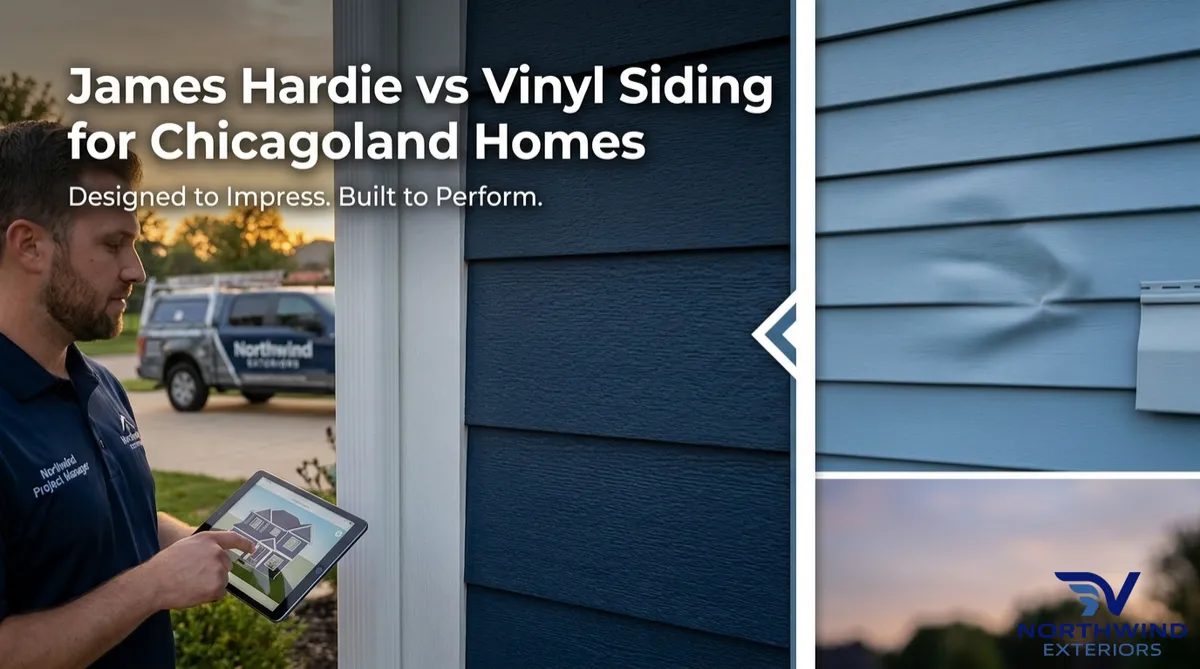
James Hardie vs Vinyl Siding for Chicagoland Homes
For most Chicagoland homes, James Hardie fiber cement siding is superior to vinyl due to its specialized HZ5® formulation, which is engineered to resist severe freeze-thaw cycles without cracking. While vinyl siding is a highly popular, budget-friendly alternative, it becomes brittle in sub-zero Chicago winters and is susceptible to impact damage and warping during rapid temperature swings.
Key related topics covered here include DaVinci Roofscapes & Brava Shake with practical context for decision-makers.
Key Aspect 1: James Hardie vs Vinyl Siding for Chicagoland Homes Essentials
The Material Chemistry: Fiber Cement vs. Polyvinyl Chloride
To understand how these siding materials perform, we must first look at their physical composition. James Hardie siding is a heavy-duty, highly engineered fiber cement material composed of Portland cement, sand, water, and cellulose wood fibers. This dense combination results in thick, rigid planks (typically 5/16-inch thick) that mimic the solid feel and authentic appearance of real wood.
In contrast, standard vinyl siding is manufactured from polyvinyl chloride (PVC) plastic. While modern manufacturing has improved its durability, vinyl remains a lightweight, flexible, and relatively thin material. These fundamental differences in material chemistry dictate how each cladding responds to thermal expansion, physical impacts, and the passage of time on your home's exterior.
Why Cladding Matters in Illinois Climate Zone 5
Northern Illinois is designated as Climate Zone 5 by the U.S. Department of Energy, which means our homes endure a demanding, heating-dominated climate. Siding in the Chicago area must survive sub-zero winter temperatures, intense lake-effect snowstorms, humid summer heatwaves, and sudden severe convective storms.
Your siding does not work in isolation; it functions as the outermost layer of a complex thermal envelope that includes wrapping, insulation, and flashing systems. Because of this, selecting a highly stable cladding is critical to preventing moisture intrusion, wood rot, and structural degradation over the lifespan of your property.
Key Aspect 2: James Hardie vs Vinyl Siding for Chicagoland Homes Essentials
Structured, FAQ-rich content on this topic often improves scanability and retrieval clarity—especially when sections answer specific questions in plain language.
Freeze-Thaw Durability: Resisting Ice Expansion
Freeze-thaw cycles are one of the most destructive natural forces acting on Chicago homes. When water penetrates behind or within an exterior cladding material and then freezes, it expands. James Hardie's HZ5® product line is specifically engineered for freeze-thaw resilience in cold climates. It incorporates proprietary additives that minimize moisture absorption, preventing the internal expansion that causes generic fiber cement brands to delaminate or crumble.
Vinyl siding, on the other hand, does not absorb water, but its installation method makes it vulnerable. Because PVC plastic expands and contracts significantly as temperatures shift, vinyl must be hung loosely on fasteners to allow it to slide back and forth. If water gets trapped behind these loose panels during a winter freeze, the expansion can put immense pressure on the interlocking seams, sometimes causing them to unclip and expose the wall sheathing beneath.
The Polar Vortex Test: Does Vinyl Siding Crack in Chicago Winters?
Yes, vinyl siding is highly susceptible to cracking during severe Chicago winters. When temperatures drop below freezing, PVC plastic undergoes a physical transition that makes it brittle. During a polar vortex, even a minor impact—such as a stone thrown by a snowblower, a stray hockey puck, or heavy wind-blown hail—can easily crack or shatter a frozen vinyl panel.
James Hardie fiber cement retains its full structural integrity and impact resistance regardless of how low the temperature plummets. It does not become brittle, shrink, or warp, providing consistent protection and peace of mind during the harshest winter weather.
Key Aspect 3: James Hardie vs Vinyl Siding for Chicagoland Homes Essentials
Analyzing Initial Siding Costs and Long-Term Value
When planning an exterior renovation, budget is always a primary consideration. A professional James Hardie Siding Installation is a premium investment. The materials are heavier, require specialized diamond-tipped cutting tools to manage silica dust, and demand highly trained, larger crews to install safely and correctly. This translates to a higher upfront cost compared to vinyl.
However, looking purely at the initial price tag can be misleading. James Hardie siding regularly delivers an exceptional return on investment (ROI) because of its long-term durability. It is designed to last over 50 years with minimal upkeep, meaning you will likely never need to replace your siding again. This makes it a highly cost-effective choice for homeowners who plan to stay in their homes long-term.
Resale Value and Return on Investment in Northern Illinois
For those considering resale value, fiber cement siding consistently ranks as one of the top home improvement projects for recapturing costs upon sale. Buyers in premium Chicagoland suburbs recognize the James Hardie brand and associate it with luxury, durability, and fire safety.
While premium vinyl options like Mastic Quest Vinyl Siding offer excellent value and higher-than-average wind resistance for budget-conscious projects, standard builder-grade vinyl can sometimes limit a home's appreciation and buyer appeal in competitive local markets. If you are trying to maximize equity and curb appeal, fiber cement is the clear winner.
Summary for James Hardie vs Vinyl Siding for Chicagoland Homes| Performance Feature | James Hardie HZ5® Siding | Mastic Quest Premium Vinyl | ASCEND Composite Cladding |
|---|---|---|---|
| Material Composition | Fiber cement (sand, cellulose, cement) | Polyvinyl Chloride (PVC) plastic | Glass-fiber reinforced polymer composite |
| Expected Lifespan | 50+ Years (30-year warranty) | 20-30 Years (limited lifetime) | 30+ Years (lifetime limited warranty) |
| Cold-Weather Durability | Excellent; engineered for freeze-thaw | Becomes brittle; prone to impact cracking | Excellent; high impact resistance |
| Fire Rating | Class A Non-Combustible | Combustible (melts rapidly under heat) | Class A Fire Rated options available |
| Relative Cost | Investment-level (High ROI) | Budget-friendly to moderate | Moderate to High |
Key Aspect 4: James Hardie vs Vinyl Siding for Chicagoland Homes Essentials
The Maintenance Equation: Baked-On Color vs. Plastic Fading
A major difference between these two materials lies in how they retain their color over the decades. Standard vinyl siding is colored throughout the plastic. Over 10 to 15 years, persistent exposure to ultraviolet (UV) radiation breaks down the PVC chemical bonds, leading to chalking, fading, and a dulling of the color. Once vinyl fades, it cannot be successfully painted because the material's rapid expansion and contraction will cause new paint to peel and flake almost immediately.
James Hardie siding features ColorPlus® Technology—a proprietary finish where multiple coats of high-performance paint are baked onto the fiber cement boards in a factory-controlled environment. This provides a highly consistent finish that is exceptionally resistant to UV rays and chipping, backed by a 15-year limited finish warranty. While Hardie Board may eventually require repainting after two decades, the material itself remains structurally sound for 50+ years.
Preserving Architectural Integrity in Chicagoland Historic Districts
Many Chicago-area municipalities, including Evanston, Riverside, and Oak Park, have designated historic preservation districts with strict building and architectural guidelines. In these areas, vinyl siding is often discouraged or outright banned because of its visible flat overlapping seams, plastic sheen, and lack of historical authenticity.
James Hardie siding perfectly replicates the deep wood grain, crisp shadow lines, and heavy-duty trim profiles of historic cedar lap siding. Because it offers authentic wood aesthetics without the constant rotting, warping, and painting hassles of natural wood, it is widely accepted and praised by local historic preservation commissions.
Key Aspect 5: James Hardie vs Vinyl Siding for Chicagoland Homes Essentials
Comprehensive Exterior Systems: Integrating Siding and Roof Envelopes
Your home's exterior must function as a single, fully integrated system to successfully shed water and manage wind loads. Siding does not work in a vacuum; it must integrate seamlessly with your roofline, gutters, soffits, and underlying house wrap. If you are planning a structural Residential Roofing Replacement, it is highly recommended to assess your siding at the same time to ensure flashing at critical roof-to-wall intersections is completely water-tight.
At Northwind Exteriors, we coordinate these complex exterior scopes. Whether you choose ultra-premium roofing materials like DaVinci Roofscapes & Brava Shake, durable architectural asphalt shingles, or modern Metal Roofing accents, our team ensures that all components—from the water-shedding valley flashings to the siding's starter strips—work together to form an impenetrable barrier.
Utilizing Drone Diagnostics and 3D Modeling (Hover)
To eliminate guesswork, we utilize advanced diagnostic and design technology during our planning phase. We conduct comprehensive Drone Roof Inspections to check high-level flashings, chimney saddles, and roof-to-wall junctions that are hard to inspect from a ladder. This allows us to spot hidden compromises before any siding is removed.
Furthermore, we leverage 3D Design Modeling (Hover) to build a highly accurate 3D rendering of your home. Using this digital canvas, you can test different James Hardie siding profiles, board-and-batten configurations, and trim colors alongside various roofing styles. This interactive visual design process ensures you are completely confident in your aesthetic choices before a single board is installed.
Key Aspect 6: James Hardie vs Vinyl Siding for Chicagoland Homes Essentials
Storm Resilience: Wind Load and Hail Deflection
Chicagoland storms can bring violent, straight-line winds, heavy lake-effect snow loads, and intense hailstorms. James Hardie fiber cement siding is highly dense and mechanically fastened directly to your home's structural framing. When installed to manufacturer specifications, it can withstand extreme wind loads of up to 150 mph, ensuring your home remains protected even during severe convective storm events.
Additionally, James Hardie's dense formulation is highly impact-resistant. While large hail can chip, puncture, or completely shatter vinyl panels, fiber cement easily deflects hail strikes, keeping your home's underlying sheathing safe from moisture exposure.
Class A Fire Safety and Homeowners Insurance Considerations
Fire safety is another critical, yet often overlooked, differentiator. James Hardie siding is classified as a noncombustible, Class A fire-rated building material. It will not ignite, melt, or act as fuel for a fire when exposed to a direct flame. Vinyl siding, because it is made of plastic, melts rapidly when exposed to a nearby heat source, such as a neighbor's house fire or even a misplaced backyard barbecue grill.
Because of this remarkable noncombustible rating and hail resistance, many insurance carriers offer premium discounts for homes clad in James Hardie siding compared to wood or vinyl. If your home has been hit by a severe storm, our team provides comprehensive, transparent Insurance Claim Assistance, providing detailed documentation to help you restore your home to building code compliance.
Key Aspect 7: James Hardie vs Vinyl Siding for Chicagoland Homes Essentials
Reviewing Options: HardiePlank HZ5® and Mastic Quest Vinyl Siding
If you choose to invest in James Hardie siding, the HZ5® product line is the industry-standard recommendation for northern Illinois homes. This product is specifically engineered with a customized surface formulation that resists snow accumulation, ice adhesion, and UV fading. It provides the ultimate balance of beauty and severe-weather performance.
However, if your project budget calls for a more cost-effective option, we recommend upgrading to a premium vinyl product like Mastic Quest Vinyl Siding. Mastic Quest is a thick, professional-grade vinyl with a double-nail hem that is engineered to withstand winds up to 240 mph. It offers a significant performance upgrade over generic, thin builder-grade vinyl, giving you peace of mind at an accessible price point.
The Composite Alternative: ASCEND Composite Cladding
For homeowners who desire a premium, modern option that sits comfortably between vinyl and fiber cement, we also install ASCEND Composite Cladding. This state-of-the-art cladding system combines glass fibers, polymer, and graphite to deliver a lightweight, exceptionally strong exterior.
ASCEND features a gorgeous wood-grain aesthetic, requires virtually zero maintenance, and comes with a built-in insulation backing that delivers an R-2.0 thermal rating. This added insulation helps reduce energy costs and keeps your home comfortable during our freezing winters and humid summers. It is a fantastic option for homeowners who want excellent impact resistance, simple installation, and superior thermal performance.
Key Aspect 8: James Hardie vs Vinyl Siding for Chicagoland Homes Essentials
Craftsmanship Standards: Why Certified Siding Installation Matters
Even the highest-quality siding materials will fail if they are installed incorrectly. Fiber cement is a heavy, rigid material that requires precise engineering during installation. Boards must be cut with specialized dust-controlling equipment, fastened with specific nails driven to exact structural depths, and spaced with precise clearance gaps from rooflines, hardscapes, and soil to prevent moisture wicking.
At Northwind Exteriors, we are proud to hold the prestigious James Hardie Alliance Elite status. This designation means our factory-trained crews adhere strictly to James Hardie's rigorous installation protocols, protecting your 30-year non-prorated product warranty and ensuring your siding system is built to perform for decades.
Clean Project Coordination: One Accountable Project Manager
Exterior remodeling can be stressful, but it doesn't have to be. Northwind Exteriors was founded by Joe Breisch on a clear promise: providing thoughtful exterior design, complete high-performance systems, and a stress-free client experience. We reject aggressive sales tactics, door-knocking gimmicks, and artificial urgency.
Whether we are working on premium residential homes, multi-family housing complexes, or complex Commercial Roofing projects, we provide you with one accountable project manager. This designated professional handles every detail—from the initial drone diagnostic inspection to the final walkthrough—ensuring clean, transparent communication, honest recommendations, and flawless craftsmanship from start to finish.
Chicagoland Siding Installation Checklist
To ensure your new siding performs flawlessly through harsh winters and humid summers, verify that your installation partner meets these rigorous standards:
- Verify Climate Zone Specifics: Confirm the contractor is installing James Hardie HZ5® (engineered for northern freeze-thaw zones) and not HZ10 (for southern climates).
- Inspect the Weather Barrier: Ensure a high-performance house wrap (like HardieWrap®) is correctly installed, taped, and flashed around doors and exterior wall penetrations to prevent water infiltration.
- Maintain Ground Clearances: Fiber cement must be installed at least 6 inches above grade and 1 to 2 inches above roof decks or hardscapes to avoid moisture wicking.
- Assess Underlayment Insulation: Use this opportunity to evaluate if adding continuous rigid foam insulation under the siding is necessary to meet Illinois Energy Code standards.
- Review Fastening Technique: Confirm nails are driven straight, flush with the siding surface, and into studs—never angled or over-driven, which voids the manufacturer's warranty.
- Check Licensing and Certification: Choose an installer with elite credentials, such as a James Hardie Alliance Elite partner, to ensure factory-trained quality.
Key Siding Strategies for Chicagoland Homeowners
Siding Decision Framework| Strategy | Why it matters |
|---|---|
| Choose Hardie HZ5® for Permanent Durability | Engineered specifically for Northern Illinois' severe freeze-thaw cycles to prevent water absorption and cracking. |
| Upgrade to Mastic Quest for Budget Savings | Provides premium-grade plastic thickness and reinforced nailing hems for high wind resistance at a lower price point. |
| Utilize 3D Modeling (Hover) for Design Phase | Visualizes siding profiles, trims, and roof material matches before construction begins to avoid design regrets. |
| Coordinate Siding with Roofing Replacement | Ensures flashing, insulation, and moisture barriers integrate seamlessly at critical roof-to-wall junctions. |
People Also Ask
Is James Hardie siding worth the extra money in Chicago?
Yes, James Hardie siding is highly worth the investment for Chicagoland homeowners. Its HZ5® formulation resists freeze-thaw cracking, extreme winds, and hail, while retaining its color and shape far better than wood or vinyl. It also increases a home's resale value and features a noncombustible Class A fire rating.
How does vinyl siding hold up in freezing Chicago winters?
Vinyl siding becomes highly brittle when exposed to freezing Chicago temperatures. Because polyvinyl chloride (PVC) contracts in the cold, it is prone to cracking or shattering from minor impacts, such as throwing ice from a snowblower, and can warp or buckle if not installed with proper expansion gaps.
Which is better for a Chicago home, vinyl or Hardie board?
Hardie Board (fiber cement) is the superior choice for overall durability, aesthetics, fire safety, and long-term ROI. However, if your budget is limited, a premium-grade product like Mastic Quest Vinyl Siding offers a highly durable, cost-effective alternative that resists high winds when professionally installed.
Sources & further reading
Frequently Asked Questions
What is the price difference between fiber cement and vinyl siding in Illinois?
On average, a professional James Hardie siding installation costs about 1.5 to 2.5 times more than standard vinyl siding. This difference accounts for the premium material cost, specialized diamond-blade cutting tools, safety gear for silica dust, and the labor-intensive nature of installing heavy fiber cement boards.
Can you paint James Hardie siding if you want to change colors?
Yes, unlike vinyl siding which cannot easily be painted, James Hardie fiber cement siding can be repainted with high-quality acrylic latex paint. If you choose the ColorPlus® pre-finished option, it comes with a 15-year warranty against fading, peeling, and chipping before any repainting is required.
Does fiber cement siding lower homeowners insurance premiums?
In many cases, yes. Because James Hardie siding is noncombustible and highly impact-resistant against hail, some insurance companies offer discounts on homeowners insurance premiums compared to homes clad in combustible wood or fragile vinyl siding. Always consult your insurance broker for specific policy details.
What is ASCEND Composite Cladding?
ASCEND Composite Cladding is a premium alternative that blends glass fibers, polymer, and graphite. It replicates the authentic look of wood but is lighter than fiber cement and comes with built-in insulation, offering excellent thermal performance and impact resistance specifically engineered for cold climates.
How long does a typical siding installation take in Chicagoland?
A full whole-home siding replacement on a standard single-family home in the Chicago suburbs typically takes between 3 and 7 working days, depending on home size, height, and detailing. Proper prep work, including removing old siding and installing weather barriers, is critical for long-term performance.
Do I need a municipal permit to replace my siding in the Chicago suburbs?
Yes, most municipalities across Cook, DuPage, Lake, and Will counties require a building permit for complete siding replacement. Historic districts, such as those in Oak Park or Evanston, also have strict architectural design guidelines regarding materials and profiles that must be approved before work begins.
Content type: Editorial guide
Expertise: James Hardie vs Vinyl Siding for Chicagoland Homes
Topics: James Hardie Vs Vinyl Siding fiber cement vs vinyl siding Chicago climate Hardie board cost vs vinyl siding Midwest best siding for Chicago weather
Editorial standards: practical guidance, sourced claims when cited, and updates when practices change.
class="ugo-cta-bridge"> Teams working with Northwind Exteriors that adopt scalable, evidence-based approaches to James Hardie vs Vinyl Siding for Chicagoland Homes are better positioned for how search and AI discovery continue to evolve. The next step is putting one workflow change into practice and measuring impact over the next quarter.Ready to Get Started?
Northwind combines thoughtful exterior design with complete, high-performance roofing, James Hardie siding, and insurance restoration systems. One accountable project manager stays involved from inspection through final completion, providing premium materials, expert installation, clear recommendations, and zero-pressure guidance.