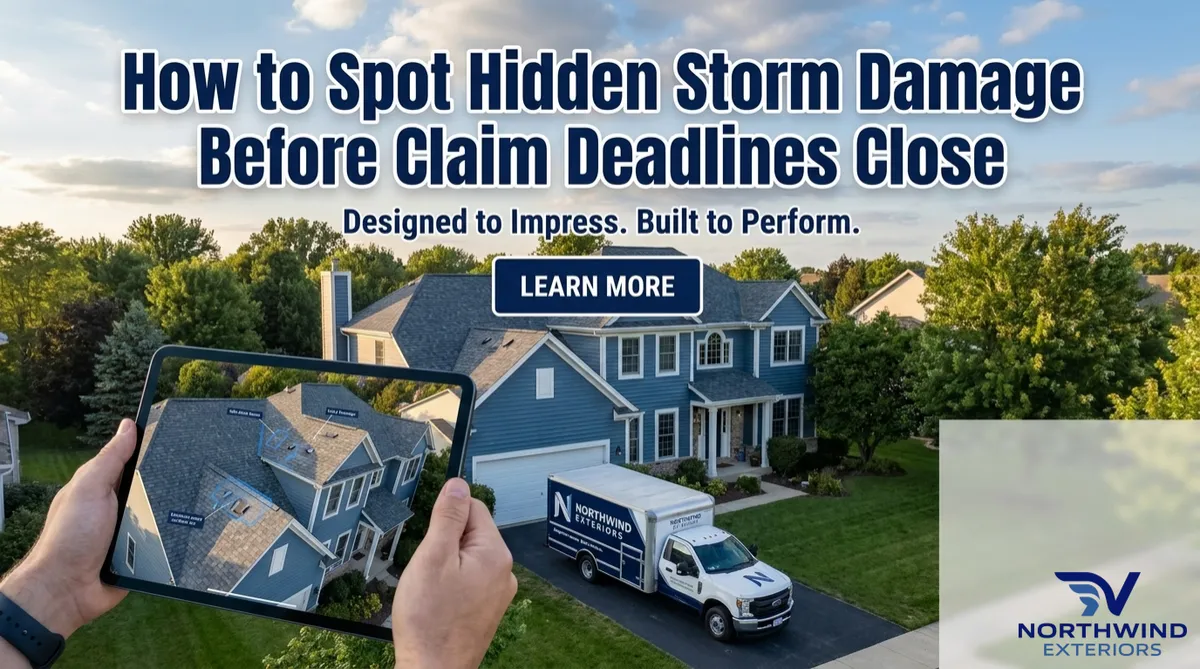
How to Spot Hidden Storm Damage Before Claim Deadlines Close
When severe weather strikes the Chicagoland region, homeowners in neighborhoods like Park Ridge, the North Shore, and the Northwest Suburbs are quick to assess their properties for obvious signs of damage. We naturally look for shattered glass, missing siding, or entire sections of shingles torn from the roof. However, the most destructive storm damage is often the kind you cannot see from your driveway. Hidden moisture intrusion, compromised structural seals, and micro-impacts on exterior cladding can quietly degrade your home over time.
Identifying these hidden issues early is vital. Not only does it protect the physical integrity of your property, but it also ensures you address these concerns before your insurance policy’s contractual claim window closes. In this educational guide, we will walk you through the precise science of spotting hidden storm damage, documenting your findings with undeniable proof, and protecting your most valuable investment.
To successfully spot hidden storm damage before your claim window closes, inspect your home for roof uplift and nail pops that compromise the water seal, use side-angle lighting to detect micro-impact hail bruising on framing or siding, and check your attic for insulation saturated by wind-driven rain. Homeowners must document this damage immediately to satisfy their insurance policy’s prompt notice clause.
Key related topics covered here include DaVinci Roofscapes & Brava Shake with practical context for decision-makers.
Key related topics covered here include Commercial Roofing with practical context for decision-makers.
When discussing this topic, How to Spot Hidden Storm Damage Before Your Claim Window Closes is one of the core concepts practitioners align on—this guide explains how it fits your workflow.
How long after a storm can you file an insurance claim for property damage?
In Illinois, the timeline for filing an insurance claim for property damage is governed by both state regulations and the specific terms of your insurance policy. Generally, most standard homeowners policies establish a contractual window of one to two years from the date of the loss to file a claim or initiate a lawsuit if a dispute arises. According to the Illinois Department of Insurance, policyholders must read their contracts carefully to understand these specific limitations, as they are legally binding. Under current 2026 guidelines, waiting too long can disqualify you from accessing essential restoration funds.
The Critical Role of "Prompt Notice" Clauses
While you may technically have up to two years to finalize a claim under Illinois law, almost all property insurance policies contain a "prompt notice" clause. This clause mandates that you report any storm damage as soon as practically possible after the event occurs. If you delay reporting hidden damage for twelve months because the roof was not actively leaking, your insurance carrier may deny coverage. They will argue that your delay prejudiced their ability to conduct a fair investigation, shifting the legal burden of proof to you to demonstrate the storm was the sole cause of the damage.
Why the Claim Window Closes Faster Than You Think
Waiting to file a claim also runs the risk of secondary damage occurring, such as rot, structural decay, or mold. If an insurer can prove that subsequent weather events or simple home neglect worsened the original storm damage, they may only pay for the initial, minor damage—or deny the claim entirely. This is why immediate, proactive inspections and professional Insurance Claim Assistance are essential after any severe wind or hail event.
How do you check your home for hidden storm damage after a wind or hail event?
Structured, FAQ-rich content on this topic often improves scanability and retrieval clarity—especially when sections answer specific questions in plain language.
Checking your home for hidden storm damage requires a systematic, disciplined approach. It is not enough to simply walk around your lawn and look up at the eaves. You must know what subtle clues to look for on different materials, ranging from your siding down to your home's foundation.

Using Side-Angle Lighting for Micro-Impact Hail Bruising
One of the most effective techniques for identifying hidden storm damage on siding is using side-angle lighting. During midday, direct sunlight can wash out subtle indentations. Instead, wait for twilight or use a high-powered LED flashlight held at a 15-to-30-degree angle against your home's exterior cladding. This casting of directional light highlights micro-impact hail bruising on materials like Mastic Quest Vinyl Siding, ASCEND Composite Cladding, or even James Hardie Siding Installation. These bruises represent structural weak points where the material's backing has fractured, even if the exterior surface appears unbroken.
Analyzing Soft Metals and Downspouts
Your gutters, downspouts, casing wraps, and metal fascia are excellent indicator materials because they are made of soft aluminum or copper. While asphalt shingles can absorb and mask hail impacts, soft metals preserve a clear physical record of the storm's intensity. Look closely at your downspouts for small, round dimples. Similarly, inspect the ground around your downspout discharge zones. An unusual accumulation of dark, sandy granules indicates that hail has stripped the protective mineral coating from your roof shingles, leaving the underlying asphalt exposed to UV degradation.
What are the hidden signs of roof wind damage like roof uplift and nail pops?
Wind damage to a roof is rarely as dramatic as a giant tree branch crashing through the rafters. More often, wind acts as a silent destabilizer, compromising your roof's water-shedding system through dynamic pressure changes.
Shingle Uplift and Nail Pops That Compromise the Water Seal
When high-velocity wind passes over a roof's ridge or eaves, it creates a powerful aerodynamic lift. This force sucks shingles upward, stretching the roofing nails and breaking the critical self-sealing adhesive strip that bonds the shingles together. Once the wind subsides, the shingles often gravity-settle back into their original position, appearing completely normal from the ground. However, this roof uplift and nail pops that compromise the water seal leave your roof highly vulnerable. The next rainfall will easily push water underneath the unsealed shingles, directly onto the underlayment and plywood decking.
Creased Shingles and Thermal Fracture
Even if shingles do not blow off entirely, wind lift can bend them backward, causing a horizontal crease along the fabric of the shingle. Over time, these creased areas lose their fiberglass structural integrity, allowing water to seep through. For homeowners looking to avoid these risks entirely, upgrading to robust systems like DaVinci Roofscapes & Brava Shake or premium Metal Roofing during a Residential Roofing Replacement provides exceptional wind-resistance ratings that stand up to severe atmospheric lift.
How does wind-driven rain damage attic insulation and cause hidden mold?
Many homeowners assume that if their ceiling isn't dripping, their roof is dry. This is a dangerous misconception. Wind-driven rain operates differently than vertical rainfall, bypassing traditional defense systems to cause hidden damage.
Bypassing Attic Ventilation Systems
Standard roof designs rely on intake soffit vents and exhaust ridge vents to regulate attic temperature and moisture. However, severe storms with high lateral winds can push rain horizontally, forcing water directly into these vents. Once water enters the attic, it falls directly onto your ceiling joists and insulation.
Saturated Insulation and the Threat of Mold
Saturated fiberglass or cellulose insulation loses its thermal resistance (R-value) instantly, leading to increased energy costs. More importantly, wet insulation trapped in a dark, warm attic creates an ideal environment for mold spores to colonize. According to the United States Environmental Protection Agency, mold can begin growing on damp organic materials within 24 to 48 hours. By the time mold spots appear on your upper-story drywall, the attic structural framing may already have extensive fungal growth and wood rot.
How can you identify storm damage to window seals and frames without broken glass?
Storm damage is not limited to your roof and siding. High-velocity winds and rapid barometric pressure drops exert extreme physical forces on your home's glazing assemblies.

Wind Pressure and Building Frame Torque
A severe storm can create immense lateral pressure on your home’s outer walls. This pressure causes micro-shifting, or building frame torque, which slightly misaligns glass frames and door casings. You can identify this hidden structural shift by walking through your home and testing every operable glass unit and exterior door. Are they suddenly sticking, binding, or requiring extra force to slide open and lock? This mechanical resistance is often a direct result of wind-induced framing torque.
Compromised Insulated Glass Seals
Modern homes rely on double- or triple-pane insulated glass units (IGUs) filled with insulating argon or krypton gas. The rapid pressure fluctuations and physical vibrations caused by nearby hail impacts can rupture the delicate perimeter seals of these units. While the glass remains completely unbroken, the insulating gas escapes, allowing moisture-laden air to seep into the chamber. This manifests weeks or months later as thermal fogging—a hazy condensation trapped permanently between the glass panes that cannot be wiped away.
What is the correct way to document hidden storm damage for an insurance claim?
The success of an insurance claim hinges entirely on the quality of your documentation. When filing for hidden damage, you must build an undeniable, evidence-based case that connects the physical issues directly to a specific weather event.
Archiving NOAA and Meteorological Radar Reports
One of the most common reasons insurance companies deny claims for hidden damage is by classifying the issues as "pre-existing wear and tear" or "gradual deterioration." To counteract this, you must prove the exact storm date. With advanced meteorology in 2026, archiving radar data is easier than ever. Immediately after an event, access and archive localized radar reports and meteorological data from the National Oceanic and Atmospheric Administration. Saving screenshots of local weather alerts, wind speed measurements, and verified hail-size reports in your area provides objective, third-party scientific proof that a severe weather event occurred at your address on that exact date.
Creating a Comprehensive Visual Evidence Log
Take high-resolution photographs and videos of your entire property. When documenting subtle damages:
- Use a physical reference object, like a coin or a ruler, next to any hail dents on metal wraps to establish scale.
- Use the side-angle lighting technique described earlier to capture high-contrast photos of micro-bruises on siding.
- Take wide-angle context shots of the home first, followed by close-ups, so the adjuster can easily locate the damaged area.
- Save all media files with date-and-time metadata enabled.
Why should you hire a professional roofing contractor to inspect hidden storm damage?
While a DIY inspection is a great starting point, a homeowner should never rely solely on their own findings. Climbing ladders and inspecting roofs is inherently dangerous and requires specialized diagnostic training to identify structural failures safely.
Leveraging Advanced Technology: Drone Inspections and Hover 3D Modeling
A premier contractor utilizes state-of-the-art diagnostic technology to locate hidden issues. At Northwind Exteriors, we employ Drone Roof Inspections to capture ultra-high-resolution aerial imagery and thermal data of your roof without putting foot on fragile shingles. We also utilize 3D Design Modeling (Hover) to construct a mathematically precise digital model of your home's exterior envelope. This technology allows us to pinpoint structural misalignments, calculate exact waste factors, and identify subtle surface deformations that a standard physical inspection would miss.
Expert Advocacy and Insurance Claim Assistance
Navigating the insurance restoration process can be overwhelming. A professional contractor provides invaluable assistance by compiling a detailed, itemized damage report. This report translates physical damage into the precise technical language and formatting that insurance adjusters expect. Having an experienced project manager present during the adjuster's inspection ensures that critical, hidden issues—like compromised water seals and wind-driven insulation saturation—are pointed out and properly accounted for in the scope of work.
What is a homeowner's duty to mitigate property damage after a severe storm?
In the world of property insurance, your rights as a policyholder are tied directly to your responsibilities. One of the most critical contractual obligations in your homeowners policy is your "duty to mitigate".
The Contractual Obligation to Prevent Secondary Damage
The duty to mitigate mandates that, following an insured loss, you must take immediate and reasonable steps to protect your property from further degradation. If a storm punctures your roof, you cannot simply leave it exposed to subsequent rainstorms while waiting for the insurance company to settle the claim. If you fail to take protective action, the insurance carrier is legally entitled to deny coverage for any secondary damage—such as rotting plywood decks, saturated drywall, or widespread mold growth—that occurs after the initial storm event.
Documenting and Reimbursing Temporary Repair Costs
Mitigation does not mean performing permanent, complex repairs yourself. It means executing temporary, defensive measures. Common mitigation actions include:
- Installing heavy-duty protective tarps over compromised roof sections.
- Boarding up broken apertures or structural openings to keep out rain and pests.
- Placing commercial-grade dehumidifiers or fans in areas affected by minor leaks.
Crucially, keep every receipt for materials purchased or professional fees paid for these emergency services. Under standard policy terms, insurance companies are contractually required to reimburse homeowners for the reasonable costs incurred during emergency mitigation.
The Homeowner's Hidden Storm Damage Inspection Checklist
Use this comprehensive diagnostic checklist within 48 hours of any severe weather event to ensure no hidden damage goes unnoticed before your claim window expires:
- Verify Storm Metadata: Save screenshots of local weather apps, wind velocities, and NOAA radar reports for your exact address.
- Assess Attic Sheathing & Vents: Check the underside of the roof deck for dark water stains, active drips, or damp insulation near soffit and ridge vents.
- Conduct Side-Angle Light Test: Shine an LED flashlight parallel to your Mastic Quest Vinyl Siding or ASCEND Composite Cladding to check for micro-bruises.
- Test Every Operable Glass Unit: Open, close, and lock every glass unit and door to check for frame binding or alignment issues caused by wind torque.
- Check Shingle Seal Integrity: Look for flapping shingles or loose nails (nail pops) along the roof's edge and valleys.
- Document Emergency Repairs: Retain receipts for tarps, plywood, and labor used to fulfill your contractually mandated duty to mitigate.
| Strategy | Why it matters |
|---|---|
| Document Storm Date with NOAA Reports | Establishes a concrete, verifiable meteorological event to counteract "wear and tear" claims and keep your insurance claim window open. |
| Use Side-Angle Lighting on Siding & Wraps | Reveals micro-impact hail bruising and minor fractures that aren't visible under direct sun, allowing you to file before the material degrades. |
| Inspect Attic Vent Pathways & Insulation | Detects wind-driven water intrusion before it leads to structural wood rot, framing degradation, and hazardous mold growth. |
| Leverage Drone Roof Inspections | Safely maps hard-to-see damage on steep or delicate roof surfaces using thermal imaging and high-resolution optical cameras. |
People Also Ask
How long do you have to report storm damage to insurance?
In most jurisdictions, including Illinois, property insurance contracts require you to report storm damage promptly or within a reasonable timeframe. Contractually, the strict deadline to file a claim or lawsuit is typically one to two years from the date of loss. Delaying beyond this window can lead to a denial based on a breach of the prompt notice clause.
Can I file an insurance claim for hidden roof damage years later?
Filing a claim several years after a storm is highly challenging. Most policies have a strict one-to-two-year limit. If you discover damage late, you must prove the damage was directly caused by the specific historical storm and explain why it was undiscovered, which often shifts the legal burden of proof to you.
What does "duty to mitigate" mean in a homeowners insurance policy?
The duty to mitigate is a contractual clause requiring you to take immediate steps to prevent additional damage to your property after a storm. This includes placing temporary tarps on roof punctures, boarding up openings, or drying out water leaks. Insurance companies typically reimburse the cost of these temporary, defensive repairs.
Frequently Asked Questions
What if my roof isn't leaking—could there still be hidden storm damage?
Absolutely. Many storm damages, such as fractured shingle mats, loose adhesive bonds from roof uplift, and micro-bruised siding, do not cause immediate interior leaks. However, they compromise the integrity of your home's exterior envelope. Over months of freeze-thaw cycles, water will eventually bypass these weak spots, causing rot and mold long after your insurance claim window has closed.
How do insurance adjusters identify hidden hail damage on a roof?
Insurance adjusters look for specific physical indicators, such as small, circular dimples in soft metals (like downspouts or copper valleys), severe mineral granule loss in gutters, and circular fractures on asphalt shingles known as bruises. When these indicators are subtle, experienced contractors use high-contrast lighting and drone imagery to map the damage patterns clearly.
Will my insurance premiums go up if I file a storm damage claim?
Under Illinois insurance regulations, insurance carriers generally cannot single out an individual policyholder for a rate increase based solely on a claim filed for a "force majeure" or natural weather event, like wind or hail. However, regional rates may adjust over time across entire ZIP codes based on the overall frequency and severity of storms in that area.
Can wind damage a casing or frame assembly without breaking the glass?
Yes. Strong wind storms apply massive lateral forces to your home's exterior walls. This pressure can cause structural torque, warping framing and door casings slightly. This leads to sticking sashes, drafts, and broken insulated glass seals, causing condensation and thermal fogging between the double panes over time.
What is the difference between "wear and tear" and storm damage?
Wear and tear is the gradual deterioration of roofing or siding materials over years due to normal weathering. Storm damage is a sudden, accidental physical loss caused by an identifiable weather event. Insurers cover storm damage but exclude normal wear and tear, which is why archiving NOAA weather data is critical to prove your claim's validity.
Does insurance reimburse the cost of temporary tarps and emergency board-ups?
Yes, standard homeowners policies cover the cost of temporary mitigation efforts. Your contractually mandated "duty to mitigate" requires you to take immediate steps to protect your property from secondary damage. Keep all receipts for tarps, plywood, and contractor labor, as these costs are fully reimbursable under the policy's emergency protection clauses.
Why should I hire a local contractor instead of a national restoration company?
Local contractors like Northwind Exteriors have deep roots in the Chicagoland community and are personally accountable for the long-term performance of your roof or siding. Unlike national restoration companies that leave immediately after a storm passes, local specialists provide dedicated project managers who coordinate the entire restoration and stand behind their workmanship for years.
Content type: Editorial guide
Expertise: How to Spot Hidden Storm Damage Before Claim Deadlines Close
Topics: How To Spot Hidden Storm how to inspect roof after storm undocumented storm damage home insurance detecting wind damage on shingles
Editorial standards: practical guidance, sourced claims when cited, and updates when practices change.
class="ugo-cta-bridge"> Teams working with Northwind Exteriors that adopt scalable, evidence-based approaches to How to Spot Hidden Storm Damage Before Your Claim Window Closes are better positioned for how search and AI discovery continue to evolve. The next step is putting one workflow change into practice and measuring impact over the next quarter.Ready to Get Started?
Northwind combines thoughtful exterior design with complete, high-performance roofing, James Hardie siding, and insurance restoration systems. One accountable project manager stays involved from inspection through final completion, providing premium materials, expert installation, clear recommendations, and zero-pressure guidance.