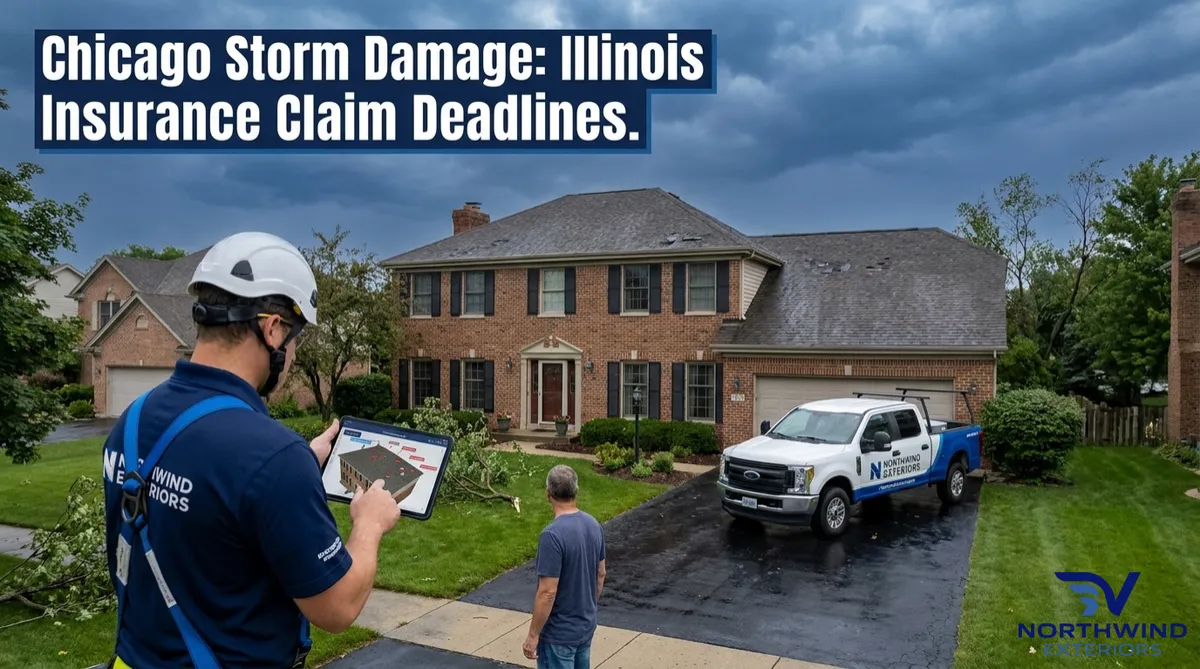
Chicago Storm Damage: Illinois Insurance Claim Deadlines
When severe weather tears through the Chicagoland area, property owners face immediate questions about how to repair their homes and navigate the complex world of insurance recovery. From high winds that rip shingles off your roof to heavy hail storms that fracture siding panels, the structural integrity of your building envelope is on the line. In the midst of dealing with active leaks and cleanup, many homeowners overlook a critical reality: the ticking clock of policy deadlines.
Understanding the legal timelines and administrative rules governing property damage claims in Illinois is the single most important step to protecting your financial interest. Whether you are dealing with minor wind damage or planning a complete residential roofing replacement, missing a deadline can leave you completely responsible for the costs of repair. This comprehensive guide outlines the exact legal and contractual deadlines that apply to Chicago storm damage, how state law protects you from insurance company delays, and the precise steps you must take to secure your recovery.
Chicago Storm Damage: Illinois Insurance Claim Deadlines — Chicagoland homeowners generally have one to two years from the exact date of loss to file a storm damage claim, depending on their policy's contractual suit-limitation provisions. Under Illinois Insurance Code Section 143.1, this suit deadline is paused (tolled) once a formal proof of loss is filed until a denial is issued.
Key related topics covered here include DaVinci Roofscapes & Brava Shake with practical context for decision-makers.
Key related topics covered here include Commercial Roofing, especially Chicago Storm Damage: Illinois Insurance Claim Deadlines, with practical context for decision-makers.
How long after a Chicago wind or hail storm do I have to report property damage to my insurance company?
The first major deadline you face after a storm is the notice of loss requirement written directly into your property insurance policy. While the final deadline to sue or fully resolve a claim might be one or two years away, your policy requires you to notify the carrier of a potential claim "promptly" or "as soon as practicable." This requirement is designed to give the insurance company an opportunity to inspect the damage before it gets worse or is obscured by subsequent weather events.
The Ambiguity of 'Prompt' Notice: What It Means in Practice
Many homeowners believe they have months to notify their carrier because of the "prompt notice" language. In practice, Illinois courts interpret "promptly" based on what a reasonable person would do under the circumstances. If you wait several months to report wind damage, and that delay allows water to leak into your home and cause extensive mold growth, your insurance carrier may deny coverage for both the mold and the roof repairs, arguing that your failure to report the damage promptly prevented them from mitigating the loss.
How Early Drone Roof Inspections Can Save Your Claim
To avoid disputes over delayed reporting, it is crucial to inspect your property immediately following a storm. Because climbing onto a compromised roof is highly dangerous, modern contractors utilize advanced technologies like Drone Roof Inspections. These high-resolution aerial scans provide timestamped, indisputable visual evidence of lifted shingles, fractured shingle backing, and hail bruising. Presenting this clear documentation to your insurance company alongside your initial notice of loss eliminates any arguments about late reporting or pre-existing wear and tear.
What is the contractual suit-limitation deadline for suing an insurance company over a denied claim in Illinois?
Structured, FAQ-rich content on Chicago Storm Damage: Illinois Insurance Claim Deadlines often improves scanability and retrieval clarity—especially when sections answer specific questions in plain language.
If your insurance company unfairly denies or underpays your storm damage claim, your ultimate recourse is to file a lawsuit in court. However, you cannot wait indefinitely to take this step. Every insurance policy in Illinois contains a critical clause known as a contractual suit-limitation provision, which dictates the exact timeframe in which you must initiate legal action against your carrier.
Contractual Suit-Limitation Provisions vs. Statutory Deadlines
Under Illinois law, the default statute of limitations for bringing a lawsuit based on the breach of a written contract is ten years (735 ILCS 5/13-206) Illinois General Assembly. For general property damage claims, the statutory limit is five years (735 ILCS 5/13-205). However, Illinois courts consistently rule that insurance companies have the legal right to contractually shorten these periods in their policies. Most homeowners insurance policies written in Illinois restrict the window for filing a lawsuit to just 12 or 24 months from the date of the loss.
Why the Standard 10-Year Contract Limit Doesn't Apply to Your Claim
Because contractual suit-limitation provisions override the statutory limits, you must carefully read your specific policy. If your policy has a one-year suit-limitation clause and a severe storm hits on June 1st, you must file a lawsuit against your insurer by June 1st of the following year if your claim is denied. Failing to file a lawsuit before this contractual deadline expires will permanently bar you from seeking legal compensation, regardless of the merits of your claim.
How does Illinois Insurance Code Section 143.1 pause or toll the deadline to file a storm damage lawsuit?
To prevent insurance companies from taking advantage of shortened suit-limitation windows, the state of Illinois established a critical safety net under Illinois Insurance Code Section 143.1 (215 ILCS 5/143.1). This statutory provision is designed to stop insurers from "sitting on" claims and running out the clock on your right to file a lawsuit.
Breaking Down the Mechanics of 215 ILCS 5/143.1
Under Section 143.1, the running of your contractual suit-limitation period is "tolled"—or paused—from the date a formal proof of loss is filed with the insurance company until the exact date the claim is formally denied in whole or in part. For example, if your policy has a one-year (365 days) suit-limitation period, and you file a proper proof of loss 90 days after the storm, the clock pauses with 275 days remaining. If the insurer takes four months to issue a formal denial, those four months do not count against your 365-day limit. The remaining 275 days only start ticking again once the written denial is in your hands.
What Constitutes a Valid 'Proof of Loss' Form under Illinois Law
The most important detail of Section 143.1 is that tolling is only triggered by the filing of a formal, policy-compliant "proof of loss." This is not merely an initial phone call or an email informing your agent of the damage. A valid proof of loss is typically a specific, signed, and notarized document detailing the exact scope of the physical damage, repair estimates, and the total financial loss. Under Illinois case law, such as American Access Casualty Company v. Tutson, if a homeowner fails to submit the exact "proof of loss" form required by the policy, the statutory tolling may not be triggered, and the lawsuit clock will continue to run without interruption.
What is the deadline for claiming recoverable depreciation on roof repairs after an Illinois insurance payout?
Most premium homeowners insurance policies are written as Replacement Cost Value (RCV) policies. However, when an insurer approves a claim for a residential roofing replacement or siding damage, they rarely pay the full replacement cost upfront. Instead, they issue a multi-stage payout that can trap unwary homeowners if strict contractual deadlines are missed.
Understanding the Recoverable Depreciation Financial Trap
When a claim is approved, the insurer first calculates the Actual Cash Value (ACV) of the damaged materials. This is done by subtracting depreciation (based on the age and wear of the roof or siding) from the total replacement cost, and then subtracting your policy's deductible. The remaining amount—the "recoverable depreciation"—is withheld by the insurance company. To recover this money, you must physically complete the repairs and submit the final invoice to your insurer proving that the replacement has been executed.
Navigating Short Replacement Timelines: 180 Days vs. 1 Year
This is where the "recoverable depreciation trap" comes into play. Most standard homeowners policies in Illinois dictate that you must complete the physical repairs and submit your final invoices within a strict timeline—typically 180 days to one year from the original date of loss or the initial ACV payment date. If you experience delays due to material shortages, municipal permitting, or poor contractor planning, and you miss this deadline, your insurance company can legally refuse to pay the withheld depreciation, leaving you to pay thousands of dollars out of pocket.
To avoid this financial hit, work with an established local general contractor who can provide comprehensive Insurance Claim Assistance. Experienced exterior partners utilize advanced measurements, such as Hover's 3D Design Modeling (Hover), to rapidly generate accurate, non-negotiable scopes of work. This accelerates the carrier's approval process and ensures your residential roofing replacement is completed and invoiced long before your policy's depreciation deadline expires.
How does the 'date of loss' get established for hidden or delayed-discovery hail damage under Illinois insurance policies?
In property insurance claims, the "date of loss" is the single most important anchor point. It determines which policy period applies, which deductible is in force, and when the contractual suit-limitation clock begins to run. For catastrophic events like a house fire or a tornado, establishing the date of loss is simple. However, for wind and hail damage, pinpointing this date can be highly contentious.
The Delayed Discovery Rule: Illinois Case Law and Shingle Damage
In some jurisdictions, courts apply a broad "delayed discovery rule" which holds that the statute of limitations does not begin to run until the homeowner discovered, or reasonably should have discovered, the physical damage. Unfortunately for Illinois policyholders, state courts apply a very narrow interpretation of the delayed discovery rule for first-party property claims. Illinois case law generally dictates that the "date of loss" is the date on which the actual physical storm event occurred, not the date the homeowner climbed onto the roof or noticed a stain on their ceiling.
Using NOAA Weather Data to Retroactively Verify the Date of Loss
Because the clock starts on the date the storm actually hit, insurance companies will cross-reference your claimed date of loss against national weather databases to ensure a severe meteorological event occurred on that day. To secure your claim, you must verify the date of loss using objective scientific data. Professional contractors will consult NOAA's Storm Events Database and localized radar history to verify hail size and wind speed reports for your exact address. This ensures that when your claim is submitted, it is tied to a verifiable, legally defensible storm date within your policy's active coverage window.
How do state emergency surveys like IEMA or Cook County OEMC impact private home insurance deadlines?
Following catastrophic storm systems in Chicagoland, municipalities and emergency agencies will often issue public appeals for residents to report property damage. Homeowners frequently confuse these public reporting mechanisms with their private insurance obligations.
Cook County OEMC vs. Private Property Claims: Know the Difference
In Cook County, the Office of Emergency Management and Communications (OEMC) or the Illinois Emergency Management Agency (IEMA) may distribute online surveys asking residents to submit damage descriptions and photos. It is vital to understand that submitting a survey to a government agency has zero legal impact on your private home insurance deadlines. These surveys are strictly designed to compile aggregate data so that local, county, and state governments can demonstrate a sufficient financial threshold of regional damage to qualify for state or federal disaster declarations (such as FEMA assistance).
Filling out a municipal damage survey does not constitute a notice of loss to your private insurer, does not satisfy your policy's contractual requirements, and does not trigger the statutory tolling protections of Section 143.1. You must still file a distinct, formal claim directly with your private insurance carrier within your policy's strict reporting windows.
Can an insurance carrier in Illinois legally deny your storm damage claim solely because of a late filing?
Homeowners often wonder if a delay in reporting storm damage automatically dooms their claim. Under Illinois law, the answer is a nuanced "yes," and it heavily favors the insurance carrier if the delay is deemed unreasonable.
The Prejudice Standard: When Late Claims Can and Cannot Be Denied
In many states, an insurance carrier cannot deny a claim for late notice unless they can prove that the delay actually "prejudiced" (harmed) their ability to investigate the loss. However, in the landmark case Country Mutual Insurance Company v. Livorsi Marine, Inc., the Illinois Supreme Court ruled that an insurance carrier is not always required to prove prejudice to successfully disclaim coverage based on late notice. Instead, the court established that once a homeowner's delay in giving notice is determined to be objectively unreasonable under all the circumstances, the policyholder forfeits coverage under the policy, regardless of whether the insurer suffered actual prejudice.
This strict legal standard means that delaying the reporting of hail damage to your siding or roof can result in a total, irreversible denial of coverage. This is especially true for materials that show gradual deterioration over time, such as standard asphalt shingles, Mastic Quest Vinyl Siding, ASCEND Composite Cladding, or custom fiber-cement cladding during a premium James Hardie Siding Installation. Timely, professional assessment is your only protection against a late-filing denial.
What legal actions can you take if a Chicago storm damage insurance claim is unfairly denied or underpaid?
If you have met all notice and proof of loss deadlines but your insurance company still wrongfully denies, delays, or underpays your storm damage claim, you are not powerless. Illinois law provides several strong avenues of recourse to hold insurance carriers accountable for bad faith practices.
Invoking 215 ILCS 5/155: Bad Faith Penalties for Chicago Insurers
The most powerful weapon in an Illinois policyholder's arsenal is Section 155 of the Illinois Insurance Code (215 ILCS 5/155). Under Section 155, if an insurance company’s behavior in handling your claim is found to be "vexatious and unreasonable," a court can order the insurer to pay significant penalties. These penalties can include your full attorney's fees, court costs, and an additional statutory penalty of up to $60,000. Common behaviors that trigger Section 155 liability include:
- Failing to perform a prompt, objective investigation of your roof or siding damage.
- Refusing to pay a claim where liability is reasonably clear.
- Offering settlement amounts that are far below the actual cost of repairs.
- Stalling negotiations in an attempt to run out your contractual suit-limitation clock.
Additionally, you can file an official administrative complaint with the Illinois Department of Insurance. While the Department cannot force an insurer to pay a disputed claim, they will investigate whether the carrier's claims-handling processes violate state regulations, which often pressures insurers to reconsider their initial decisions.
What steps should Chicagoland homeowners take immediately following a major storm to preserve their legal right to compensation?
To navigate the strict deadlines, tolling provisions, and documentation requirements of Illinois insurance law, Chicagoland homeowners must take structured, decisive action immediately following a storm. Preserving your legal right to fair compensation requires a disciplined approach to documentation and professional evaluation.
The Post-Storm Exterior Checklist: Acting Quickly and Accurately
To ensure your claim stands up to insurance company scrutiny, follow this step-by-step process:
- Perform a Visual Ground Assessment: Walk around your property and document any visible damage, such as fallen tree limbs, missing shingles, cracked siding, or dented downspouts. Use a camera to capture high-resolution, timestamped photos of the immediate aftermath.
- Deploy Professional Aerial Inspections: Schedule a comprehensive evaluation utilizing advanced drone imaging. This ensures hard-to-see impacts on steep slopes, Metal Roofing, or premium specialty materials like DaVinci Roofscapes & Brava Shake are thoroughly documented.
- Generate a 3D Digital Model: Work with an expert contractor who utilizes Hover's 3D modeling tools. This establishes accurate, non-negotiable physical dimensions of your home’s exterior, preventing disputes over material quantities.
- File Notice Promptly: Contact your insurance company immediately to report the occurrence. Even if the full extent of the damage is still being evaluated, notifying your carrier within days of the storm satisfies the "prompt notice" clause.
- Submit a Signed, Sworn Proof of Loss: Work with your general contractor and, if necessary, legal counsel to submit a formal proof of loss document. This officially triggers the statutory tolling of your lawsuit clock under 215 ILCS 5/143.1.
Rather than dealing with a disjointed team of temporary salespeople, partner with an established, licensed local general contractor. A dedicated exterior restoration partner will provide one accountable project manager to oversee your entire recovery—from initial inspection and detailed documentation to the final physical restoration of your home's complete roofing and siding systems.
Chicagoland Post-Storm Claim Survival Checklist
- Document the Date & Time: Note the exact date and hour the storm hit and match it with local severe weather alerts.
- Schedule a Drone Roof Inspection: Deploy aerial imaging early to map high-resolution, time-stamped photos of shingle lifting or hail impact.
- Request 3D Design Modeling (Hover): Create a precise digital twin of your home's exterior to establish pre-repair measurements.
- Acquire a Local Repair Estimate: Partner with an established, licensed local contractor rather than out-of-state companies.
- Submit Your Claim Immediately: Initiate the process with your carrier within days of the storm to establish 'prompt notice.'
- File a Sworn Proof of Loss: Submit a notarized, formal proof of loss to activate statutory tolling under 215 ILCS 5/143.1.
| Strategy | Why it matters |
|---|---|
| Act within the 1-to-2-year suit window | Most standard policies in Illinois contractually shorten the default 10-year written contract statute of limitations to a 12-to-24-month window starting from the date of loss. |
| Submit a formal Sworn Proof of Loss | Filing a compliant proof of loss officially activates the tolling protection under 215 ILCS 5/143.1, pausing your deadline to sue if the carrier stalls. |
| Claim recoverable depreciation early | Failing to physically complete your residential roofing replacement within the policy's strict 180-day to 1-year timeline can cause you to lose thousands in withheld depreciation payouts. |
| Verify storm dates with NOAA records | Establishing an objective 'date of loss' using NOAA and local meteorological data is crucial for validating claims involving hidden or delayed-discovery wind and hail damage. |
People Also Ask
How long after a Chicago storm do I have to file an insurance claim?
Most Illinois homeowners policies contain contractual provisions limiting your filing window to one or two years from the actual date of loss (the storm date). It is highly recommended to file within the first 48 hours to avoid disputes over delayed notice or deteriorating property conditions.
Is there a strict deadline for storm damage claims in Illinois?
While Illinois state law does not establish a universal statutory deadline for filing claims, it strictly enforces the contractual suit-limitation provisions written into your insurance policy, which typically mandate action within 12 to 24 months of the storm event.
What happens if I file my Illinois storm damage claim late?
If you file past your policy's notice or suit deadline, your insurance carrier may legally deny your claim. Under Illinois law, they can do so if the delay is deemed unreasonable, and they are not always required to prove they were prejudiced by your late filing.
Frequently Asked Questions
What is the difference between statutory deadlines and contractual suit-limitation provisions in Illinois?
In Illinois, the default statutory deadline to sue for breach of a written contract is 10 years. However, Illinois courts permit insurance carriers to contractually shorten this window within the policy language—usually to just 1 or 2 years from the date of loss—making the contractual limitation the binding deadline.
How does Illinois Insurance Code Section 143.1 protect homeowners?
Section 143.1 prevents insurance companies from running out your lawsuit clock while they evaluate your claim. Once you file a proper proof of loss, the clock pauses (tolls) and only resumes running on the date the insurer issues a formal written denial of the claim, in whole or in part.
What constitutes a valid 'proof of loss' form to pause the lawsuit clock?
A valid proof of loss is typically a sworn, signed, and notarized statement detailing the damage, repair estimates, and financial loss. Under Illinois case law, informal communications may not always suffice, so submitting a formal, policy-compliant document is critical to ensure tolling under Section 143.1.
Can I recover depreciation if my roof repairs take longer than a year?
Most policies require you to physically complete the repairs and submit final invoices within 180 days to 1 year from the date of loss to recover withheld depreciation. If your residential roofing replacement is delayed, you must request a written extension from your insurer to avoid losing these funds.
How is the 'date of loss' determined for gradual or hidden hail damage in Illinois?
In Illinois, the date of loss is strictly defined as the date the meteorological event (the storm) occurred, rather than when the homeowner discovered the damage. To validate your claim, you must tie the damage to a specific, recorded storm using historical NOAA weather data.
Does reporting storm damage to the Cook County OEMC count as filing a claim?
No, submitting information to the Cook County Office of Emergency Management and Communications (OEMC) or the Illinois Emergency Management Agency (IEMA) is strictly for public disaster assessments. You must file a separate, private claim directly with your insurance company to receive compensation.
Content type: Editorial guide
Expertise: Chicago Storm Damage: Illinois Insurance Claim Deadlines
Topics: Chicago Storm Damage: Illinois Insurance Claim Deadlines Chicago Storm Damage: Illinois Insurance Illinois home insurance claim time limit how long after storm to report roof damage Chicago
Editorial standards: practical guidance, sourced claims when cited, and updates when practices change.
class="ugo-cta" aria-label="Call to action">Ready to Get Started?
Discover how Northwind Exteriors can help you achieve your goals.